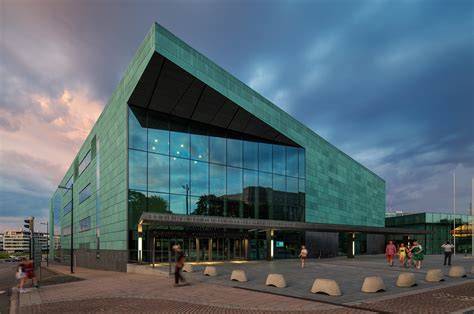
World’s largest modern concert organ is Helsinki Music Centre’s crowning gloryJanuary 2024 saw the unveiling of Musiikkitalo’s long-awaited new concert organ. The 124-stop organ has the distinction of being the largest modern concert hall organ in the world. It is also one of only two instruments of this kind that can also be considered works of art in their own right. The creation of the new organ was made possible through a significant donation from the composer Kaija Saariaho.Inaugurated in January 2024, the new organ is our venue’s crowning feature. The scheme for a new organ was revived in 2017 following a one-million-euro donation from Kaija Saariaho. Further funding was provided by the City of Helsinki, the Ministry of Education and Culture and a number of charitable foundations. The total cost of the project was EUR 4.4 million. Further financial support came from a large number of private donors who sponsored individual pipes in their name. The truly one-of-a-kind instrument was handcrafted in Austria by Rieger Orgelbau.
Limties kūrybiniam potencialui: organas kaip instrumentas ateičiai
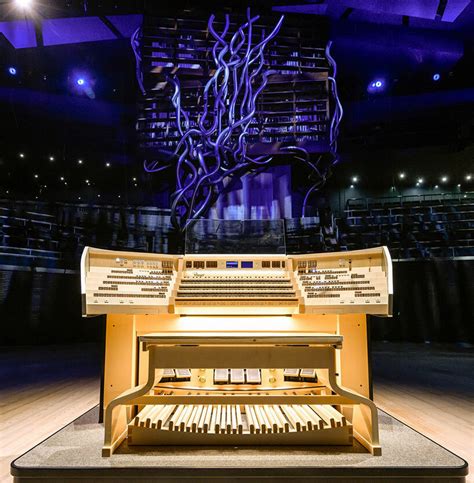
Unlimited creative potentialFrom the project’s inception, what mattered was ensuring that the new organ would lend itself to performing new contemporary music. The organ was always envisaged as an instrument of the future, with a rich sound that suits many different types of music. With its thoughtfully chosen accessories and technical features, including microtonal pipes, adjustable pneumatics and a wide range of overtone stops, it offers a fascinating creative tool for composers. The instrument is equipped with two consoles, one positioned on the gallery with the organ proper and the other on stage. This allows the organist to be seated next to the conductor and in full view of the audience.
Initially, the plan was to build an organ with 50 to 60 stops, but during the course of the project the design doubled in size to 124 stops. The swell shutters are positioned horizontally, which offers significant advantages musically. They are designed to allow for expressive dynamic variation across all the divisions of the instrument. Every organ is a unique instrument with its own distinctive sound. For the Helsinki Music Centre organ, the focus was on achieving a typical German sound, complemented by a French-Romantic sound from the Récit division. Combining these two sounds is a distinctive and unique choice, and no other organ in the world is set up to offer it.
Meilės meno ir technologijų harmonija
A feast for the eyes as well as the earsAlongside the sound, the issue of how the organ’s façade should look was also debated extensively by the experts leading the design. Their priority was to ensure that, rather than the instrument being hidden away while not in use, it would be permanently visible to audiences in all its glory. The designers ultimately opted for a truly monumental design, and Helsinki Music Centre is now home to an organ that can be considered not only a musical instrument but also a work of art in its own right. There are currently only two organs of this kind in the world. When the swell shutters are open, visitors are able to see inside the instrument itself. Unusually, the 7,999 pipes that make up the organ are placed inside the instrument. Visible on the outside is the wind system, which is responsible for supplying air to the pipes.
According to the design team, what they wanted was to create a façade that would allow the organ to exist as a living organism within the concert hall. This is an instrument that breathes, after all. The visible wind lines draw their inspiration from a number of artists and architectural designs, both at home and internationally, including the Centre Pompidou in Paris and the Sibelius Monument in Helsinki. Notably, the wind lines are not just an aesthetic feature but also a functional part of the instrument. The ten wind lines at the front are flanked by four wooden pipes on either side. The organ and the audience not only inhabit the same space, they also breathe the same air.
Meistrų komanda ir laikinas grojimo šokis
A masterpiece built by a team of 60 experts from a variety of disciplines, the Helsinki Music Centre organ will be brought to life, time and time again, as the organist begins to play. In that moment, as the apparatus transforms into a musical instrument, the listeners will forget about the technology and embrace the art. There is no substitute for experiencing the gorgeous richness of the organ’s tonal palette and the live concert’s sonic impact first hand. We look forward to welcoming you at Helsinki Music Centre!
Laiko linija: laikotarpiai, kuriant organą
- 2006 Construction begins on Helsinki Music Centre
- A group of experts produces draft spatial and façade designs for a new organ
- 2007 Organ project halted due to lack of funding
- 2011 Helsinki Music Centre opens on 31 August 2011
- 2017 Kaija Saariaho makes a donation of 1 million euros for the construction of a new organ at Helsinki Music Centre
- The City of Helsinki, the Ministry of Education and Culture and a series of charitable foundations announce further funding for the organ project
- 2018 Contract signed with Rieger Orgelbau
- 2019 The Musiikkitalon Urut Soimaan association is set up to promote active creative engagement with the new organ
- 2020 The construction of the organ begins in Austria
- 2021 The first organ parts are delivered for installation in the Concert Hall during the summer
- 2022 The organ’s 8,000 pipes and mechanism arrive at Helsinki Music Centre for installation over the summer months
- 2024 Helsinki Music Centre’s new organ is inaugurated on 1 January 2024
Structural work gets underway at Helsinki Music Centre during the summer season. The finishing touches are made to the organ’s sound and the façade is built during the summer season. The organ is tested during the last three months of the year. A documentary charting the organ project is broadcast.
How does a pipe organ actually work? | Anna Lapwood | Classic FM
Susitikimas su Sibelius Monumentu: skaitmeninės akimirkos ir atmintis
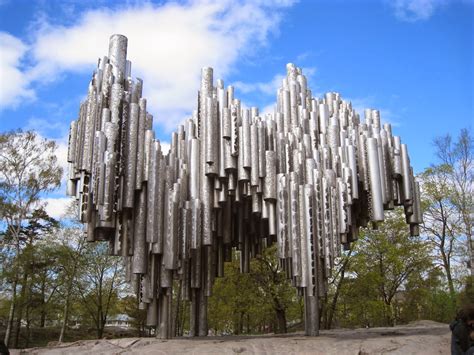
The Sibelius Monument (Finnish: Sibelius-monumentti; Swedish: Sibeliusmonumentet) is a public art memorial to the Finnish composer Jean Sibelius, who died in 1957. Situated in Sibelius Park within the Töölö district of Helsinki, the monument is by the Finnish sculptor Eila Hiltunen, whose design-Passio Musicae (originally Credo)-won a two-round competition the Sibelius Society of Finland held from 1961 to 1962. After five additional years of work by Hiltunen and her assistants, the realized monument received its unveiling at a ceremony on 7 September 1967, when the Sibelius Society donated it to the City of Helsinki.
Podobiai kūriniai praturtino Helsinkio kultūrinį peizažą, o Sibelius Monument tapo vienu labiausiai lankomų miesto meno objektų. The monument comprises two distinct elements - pipe cluster and a high-relief portrait of Sibelius. The sculpture sparked debates about abstract art in public spaces, yet today it is celebrated for its innovative fusion of wind, metal, and landscape. Visitors can walk around and partially beneath the sculpture, and wind through its pipes sometimes creates soft echoes and resonant sounds.
Apie Musiikkitalo ir jo organo įtaką kultūrai
The Sibelius Monument proved influential in several respects. Most immediately, its effect on Hiltunen's career was transformative: international recognition, exhibitions, and commissions followed, and she quickly earned a reputation as Finland's most important sculptors. The monument's realization coincided with shifts in mid-century Finnish culture, where abstract public art gradually gained acceptance as a modern national expression. The organ at Helsinki Music Centre stands as a contemporary analogue, merging German clarity with French symphonic color, and embodying a living organism that breathes with the hall’s audience.